
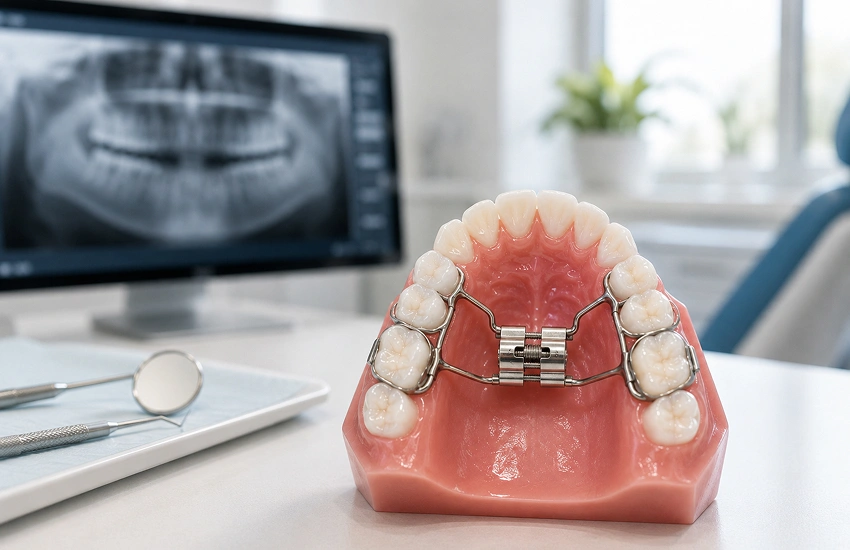
A palate expander is an orthodontic appliance used during childhood to widen the upper jaw while it is developing and does not fit properly with the lower jaw. The idea may sound striking at first, but it is actually part of highly planned and common treatments within interceptive orthodontics.
Sometimes it is indicated for a crossbite; other times, to create space for permanent teeth or to improve how the arches relate while the child is still growing. The most important thing is not to decide based solely on a photo or because “the teeth look crooked,” but after a complete assessment of the bite, growth, and habits.
What is a palate expander and when is it used
An expander, also called a palatal expander or rapid maxillary expander depending on the type, is placed on the palate and acts by gradually opening the upper arch. The idea is not to move teeth as braces would, but to modify the width of the jaw at a stage when the bone responds best.
In pediatric dentistry, it is primarily used when there is a narrow palate that affects the fit of the bite or leaves little room for the eruption of permanent teeth. It is usually considered during mixed dentition, when baby teeth and permanent teeth coexist, and is integrated into interceptive orthodontics: an early treatment that guides growth before the problem progresses.
Not all children with crowding or crooked teeth need an expander. The indication is decided after assessing occlusion, facial growth, and habits such as mouth breathing, atypical swallowing, or thumb sucking. The condition of the gums, the presence of cavities, and the child’s ability to maintain good hygiene with the appliance are also reviewed.
When acting in time on a narrow jaw, many corrections can be simpler and more stable than if waiting for more advanced stages of growth.
At the clinic, it is most common for the orthodontist to propose the expander as part of a phased plan. Sometimes it is the first step to create space and normalize the bite; other times, it is combined with habit control, pediatric dentistry, or a second phase of alignment later on.
Common reasons for recommending it in children and adolescents
The recommendation is not based solely on gaining space. The goal is to balance the relationship between arches so that the bite functions correctly and facial development follows a more favorable pattern. When the upper jaw is narrow, the child may compensate by shifting the lower jaw to one side, chewing asymmetrically, or developing unhealthy dental contacts.
In practice, these are some frequent situations in which the orthodontist may consider palatal expansion:
- Posterior crossbite, when one or more upper teeth bite inside the lower ones.
- Narrow upper arch, with a lack of space for permanent teeth.
- Functional deviation of the jaw when closing.
- High and arched palate, sometimes associated with persistent oral habits.
- Asymmetrical chewing or uneven wear on some teeth.
After identifying the reason, it is useful to understand the rationale behind the proposal. A typical case is crossbite in children, where widening the jaw can help the fit normalize without forcing the lower jaw to adopt a compensatory position.
There are also cases where expansion is planned to improve available space before certain permanent teeth erupt. This does not mean the treatment will always avoid a second phase of orthodontics, but it can make the subsequent plan more orderly and predictable.
Benefits of widening the upper jaw
An upper jaw with an adequate width improves the way the arches fit together when biting. The first benefit is usually a more stable contact: the upper teeth cover the lower ones as expected, and the jaw does not have to find an alternative position to close.
Space is also usually gained for the eruption of permanent teeth, which can facilitate a later second phase of alignment and, in some cases, reduce the need for additional maneuvers to create space. It does not mean that extractions or longer treatments are always avoided, but it can help make the plan more predictable.
In children, expansion is well integrated into a joint approach between pediatric orthodontics and preventive dentistry. In addition to studying the bite and growth, hygiene, cavities, and the condition of the gums are reviewed so that the treatment progresses safely.
When there are habits that influence the shape of the palate, such as mouth breathing or atypical swallowing, the expander is not the sole solution. However, it can be a key piece in normalizing the bone framework while working on the rest with the appropriate team. In these cases, coordination with speech therapy, ENT, or other professionals may be useful if the diagnosis requires it.
At what age is it usually best to start
The ideal age is not an exact figure; it depends more on the stage of growth and the problem to be corrected. Generally speaking, jaw expansion works best when the palate suture is more adaptable, something that usually happens during childhood and pre-adolescence.
For this reason, many plans are proposed during mixed dentition, approximately between ages 6 and 10-12, although there are variations. In some cases, the indication is detected earlier, for example, in the presence of a clear crossbite. In others, it is decided to wait and monitor progress if the child is still in the middle of tooth eruption.
Starting early does not mean treating as a rule. What is useful is arriving in time when there is a real indication. Early review allows for detecting whether the problem is dental, skeletal, or functional, and whether coordination with other professionals, such as an ENT or speech therapist, is advisable.
The first check-up helps observe how the molars fit, how the incisors erupt, and if there are signs of lack of space or jaw compensations.
From there, if the specialist recommends palatal expansion, they will explain the type of appliance, the activation schedule, and the follow-up. Furthermore, from a pediatric dentistry perspective, it is advisable to check for cavities and habits so that the child wears the appliance with fewer risks.
How the expander works step by step
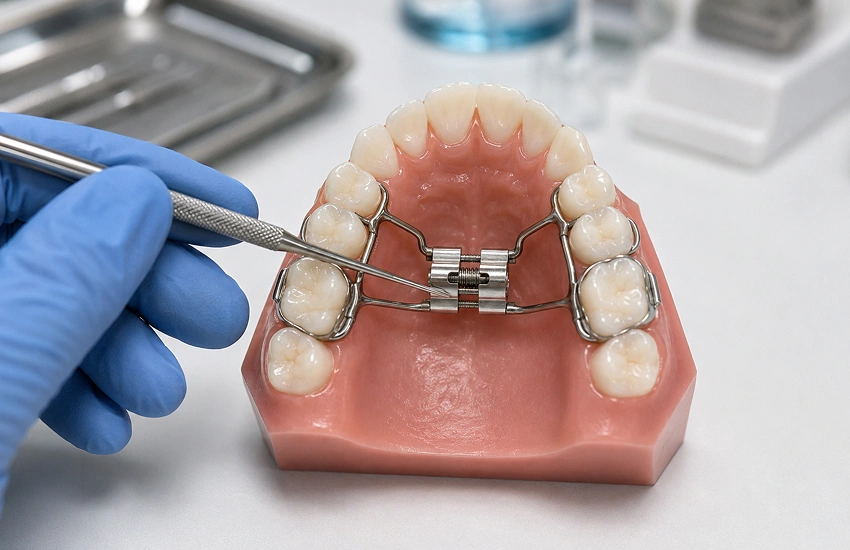
Although there are several models, many fixed expanders share a common mechanism: a central screw that, when activated, gradually separates the two halves of the appliance and transmits this force to the jaw. Activation must always follow the orthodontist’s instructions, as the pace depends on the goal, age, and the child’s response.
On the day of placement, the child usually notices a feeling of fullness in the palate and a change in the way they swallow or speak. A sensation of pressure is normal during the first few days or after each activation. Discomfort is usually temporary; if there is intense pain, sores, or persistent headaches, the clinic should be notified to check the adjustment.
A very common sign during the active phase is the appearance of a small space between the upper incisors, a temporary diastema. In many cases, it closes naturally as the treatment progresses or when moving to the next phase.
Expansion is usually felt more as pressure than pain, and check-ups serve to adapt the pace to the child’s tolerance and progress.
Throughout the process, the orthodontist monitors not only the width achieved but also the shape of the arch, the bite, and how the tissues behave. This follow-up is key to avoiding unwanted movements and deciding when the active phase ends.
Care during treatment and typical duration
The total duration depends on the goal and the type of expander. There is usually an active phase, when activations are made, and a subsequent retention phase, when the appliance is left unactivated to stabilize the bone and tissues. Therefore, although visible expansion can be achieved relatively quickly, the appliance is usually kept in place for several months.
Regarding care, the most relevant aspect is hygiene. The expander creates areas where plaque is easily retained, especially around bands or supports. In addition to regular brushing, a more meticulous cleaning with interproximal brushes or an irrigator is usually recommended, depending on the case.
To make it easier to follow at home, this checklist usually works well:
- Thorough brushing after every meal.
- Interdental brushes in the area of the screw and bands.
- Alcohol-free mouthwash if indicated by the professional.
- Avoid candies, chewing gum, and very hard foods.
- Check for chafing before ulcers form.
A good guideline is for the pediatric dentist to supervise hygiene and cavity risk during treatment. If the child accumulates plaque around the appliance, gum inflammation, bad breath, or small lesions may appear, which could make them eat poorly or brush with more fear.
As a general reference regarding timing, the American Association of Orthodontists explains that expanders usually work in phases: initial activation and a subsequent stage to help stabilize the jaw before the next step of the palatal expander treatment. In practice, the schedule is always adjusted to the case and the child’s response.
What to expect when removing it and common problems
After removing the expander, most children feel immediate relief as they regain space in the palate. However, the work does not always end that day: depending on the case, a retainer may be indicated or a move to another phase to align teeth and adjust bite details.
It is important to understand that the goal is not just to open the arch, but to maintain the result. Therefore, the professional will talk about stability, habits, and follow-up. If the expansion was done to correct a crossbite, it is checked that the fit remains stable when chewing and closing.
Regarding problems, the most common ones are usually manageable if detected early. During treatment, chafing, trapped debris that irritates the mucosa, or minor gum inflammation due to insufficient hygiene may occur. If the appliance becomes loose, moves, or pokes, it should not be forced or adjusted at home: it must be checked at the clinic.
In the event of a moving appliance, sores that do not improve, or increasing pain, the most prudent course of action is to have it checked as soon as possible to prevent the child from stopping eating or brushing properly.
It is also normal for diction to change or salivation to increase at the beginning. This adaptation usually improves within a few days. If the child has great difficulty eating, sleeps poorly due to discomfort, or complains continuously, the orthodontist can adjust the plan and provide specific guidelines.
Palatal expansion in children: when to request an assessment
If you notice that your child has a crooked bite, always chews on one side, has a very narrow upper arch, or shows signs of early crowding, it is worth requesting a personalized assessment. The earlier the problem is detected, the more options there are to propose a phased plan with clear objectives.
The decision to use an expander should not be based solely on a photo or a passing comment. It is supported by clinical examination, a study of the bite, and, when necessary, complementary tests. With this information, the most appropriate type of appliance and follow-up pace for the child can be chosen.
A good diagnosis in time can prevent a transverse problem from becoming complicated and, if treatment is necessary, the child usually adapts better when they understand what will be done and why.


