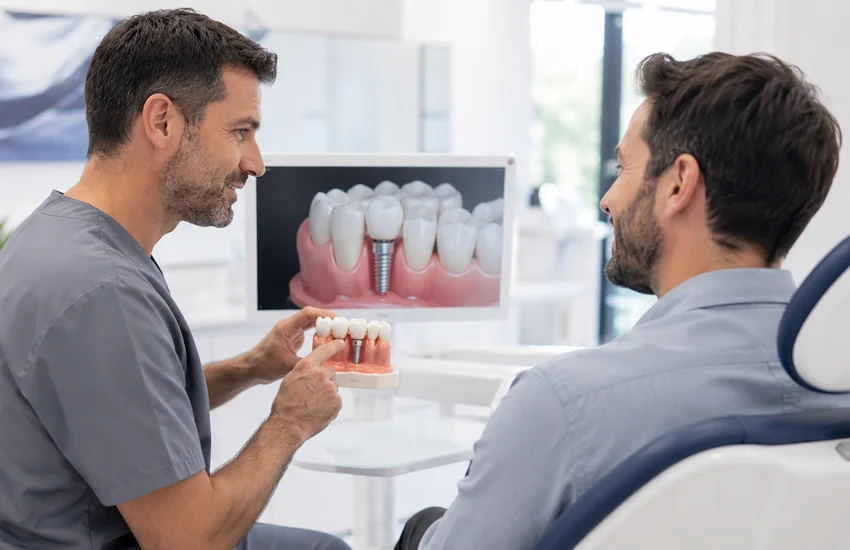
The dental implant surgery often commands respect due to its name, but in practice, it is a highly planned procedure: the case is studied, the implant is placed, and healing is monitored step by step.
What is most reassuring is understanding what is done in each phase, what discomfort can be expected, which habits help, and in which situations it is advisable to have a check-up as soon as possible. When the plan is well explained, the intervention ceases to seem abstract and becomes a much more comprehensible sequence.
What is Dental Implant Surgery and When is it Indicated?
A dental implant is an artificial root placed in the bone to later support a crown, bridge, or prosthesis. The surgery is the phase where this implant, usually made of titanium, is inserted, and the tissue is prepared for proper healing. In most cases, it is performed under local anesthesia, and the goal is for the post-operative period to be predictable, with controllable discomfort.
Before considering if it will hurt or how long it will take, it is important to clarify if the implant is the most suitable option. It may be indicated when a tooth is missing, when several teeth are missing, or when a removable prosthesis does not provide enough stability. The Mayo Clinic guide on dental implant surgery [EXTERNAL] explains that it can be an alternative when dentures or bridges do not fit well, or when there are not enough dental roots to support other solutions.
However, it is not always a case of “implant no matter what.” Sometimes, a bridge is well indicated; other times, a removable prosthesis can be a temporary or definitive option due to general health, budget, or preferences. The important thing is to calmly compare the maintenance required for each alternative, the functional expectations it offers, and its limitations.
In cases where an implant is suitable, it is also assessed whether prior treatment will be necessary. If there are inflamed gums, active cavities, or accumulated plaque, it is usually preferable to correct this environment first. Placing an implant in a mouth with inflammation increases the risk of complications and can compromise the long-term outcome.
Peace of mind usually comes from planning: when the diagnosis is well made, the intervention and recovery tend to be much more manageable.
Prior Evaluation and Treatment Planning
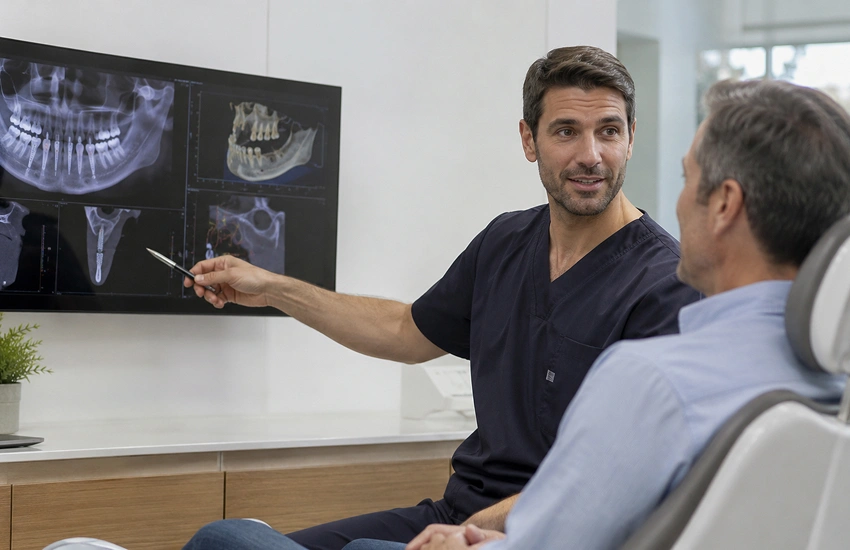
The most decisive part does not happen on the day of the intervention, but before. During the first visit, the mouth, bite, gum condition, and available bone quantity are reviewed. This is usually complemented with X-rays and, when necessary, with a 3D scan to refine measurements and reduce unforeseen events.
In this phase, habits and medical history are also reviewed: smoking, bruxism, medication, general illnesses, and any factor that may affect healing. The aim is not to scare, but to design a realistic and safe plan. An implant does not depend only on the screw; it depends on the bone, the gum, and the load it will receive during chewing.
Based on this information, it is decided whether the implant will be placed and allowed to heal, whether a provisional crown can be considered, or if the tissue needs to be prepared beforehand with a bone or gum graft. It is also defined whether the surgery will be conventional or guided, and what timelines are reasonable for each case.
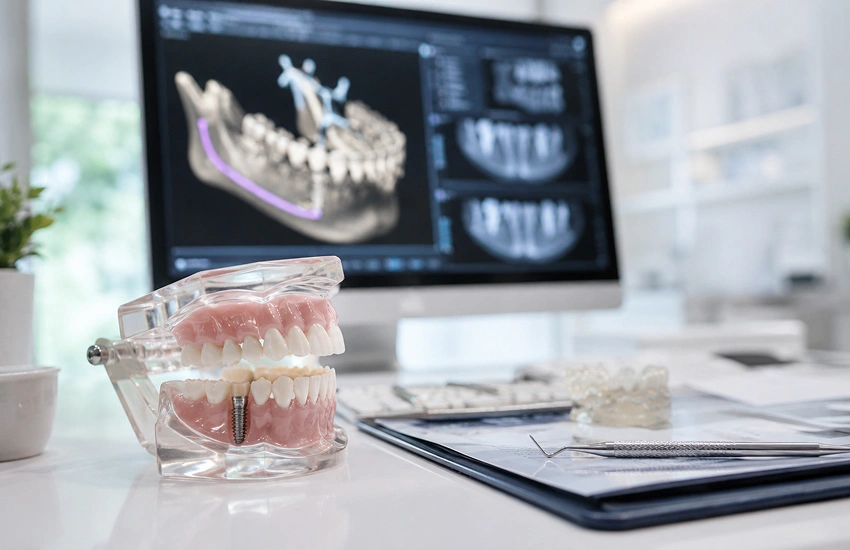
When the case allows, implant placement can be planned with digital technology to help predict the implant’s position and the future prosthesis. This global vision avoids isolated decisions, such as placing an implant in an area that later does not allow for a well-integrated crown or a stable bite.
Step-by-Step Intervention
The day of surgery is usually simpler than it seems from the outside. The area is anesthetized, work is done with precision, and the area is left clean and protected to heal. The most common sensation during the intervention is pressure or manipulation, not pain; afterwards, the area will remain numb from the anesthesia.
In general terms, the intervention includes careful preparation of the surgical field, access to the gum, bone preparation with irrigation, implant insertion, and closure with stitches if necessary. In some cases, a healing abutment is placed; in others, the implant remains covered by the gum during an initial phase.
To have a clear mental map, these are the phases that are usually repeated in many surgeries:
- Local anesthesia and confirmation of no pain.
- Access to the area and preparation of the implant bed.
- Implant placement with adequate stability.
- Bleeding control and cleaning of the area.
- Sutures and home care instructions.
The exact details change according to complexity. Therefore, understanding the placement process helps to understand what is decided at each stage and why some phases may vary between patients.
If the intervention includes an extraction at the same time, the area may be slightly more sensitive, and the professional will adjust the suture to stabilize the gum. In many cases, the actual working time is short, and what is most carefully managed is the prior preparation, anesthesia verification, and implant stability.
Afterward, written instructions are provided: what to do if it bleeds, what to eat that day, when to resume brushing, and what medication to take. Keeping and following these instructions reduces most scares, as many discomforts are better controlled when acting in an organized manner from day one.
Common Techniques: Guided Surgery, Immediate Loading, and Grafts
In modern implantology, there is much talk about guided surgery, immediate loading, and grafts, and it is important to place each concept in its proper context. They are not “better” by default nor are they suitable for all cases: they are tools indicated when the diagnosis allows.
Guided surgery is based on digital planning and a surgical guide to improve placement precision. In certain cases, it can help reduce intervention time or work more conservatively with tissues, although it does not eliminate the need to assess bone, gum, and bite.
Immediate loading involves leaving with a fixed provisional tooth or prosthesis on the same day or within a very short period. It can be an option when the bone allows, the initial stability of the implant is good, and the bite can be controlled. Immediate loading should not be considered a shortcut, but rather a possibility that requires specific conditions.
Bone or gum grafts are considered when there is insufficient volume or when it is beneficial to reinforce the tissue seal around the implant. Sometimes they are performed during the same surgery; other times, in a prior phase. The key is to avoid rushing: an implant needs stable support and healthy gum to last.
Pain and Recovery After Surgery
Most patients fear pain, but it usually resembles the discomfort after an extraction: moderate swelling, a feeling of pressure, and sensitivity when chewing. The medication plan and home care instructions make a big difference.
During the first 48–72 hours, the priority is to protect the clot and the wound, control inflammation, and avoid impacts, heat, or intense exertion. Although each case has its own guidelines, there are recommendations that are often repeated because they are simple and effective:
- Apply external cold intermittently, without burning the skin.
- Rest and sleep with your head slightly elevated.
- Maintain a soft and lukewarm diet for the first few days.
- Avoid intense exercise if bleeding or swelling increases.
- Brush the rest of the mouth and gently clean the operated area.
- Do not smoke, or reduce it as much as possible, as it worsens healing.
Regarding hygiene, the rest of the mouth should be brushed normally, and the operated area treated with care. No aggressive brushing or strong rinses on the first day, unless indicated otherwise by the professional. Later, surgical brushes, specific mouthwashes, or irrigation may be introduced if the case requires it.
After the first week, the tissue is usually much more stable, and if the stitches are not resorbable, they are removed at the clinic. However, internal healing continues. Feeling well after a few days does not mean that the bone is completely ready to receive intense chewing load.
In recovery, the goal is not to endure: it is to control inflammation and protect the wound so that the implant has the best possible environment.
Warning Signs and Possible Complications
Talking about risks is not to alarm, but to know what is to be expected and what needs to be checked. Implantology can have high success rates when well indicated, but it is not magic: it depends on the diagnosis, the technique, individual healing, and subsequent care.
Slight bleeding at the beginning can be normal, but bleeding that repeatedly soaks gauze or does not stop with pressure requires a check-up. It is also advisable to consult if fever appears, pain that does not improve with prescribed medication, swelling that worsens after the third day, or persistent bad taste associated with pus.
These signs warrant a call or a check-up without delay:
- Persistent bleeding that does not stop with pressure.
- Increasing pain despite following prescribed medication.
- Swelling that worsens after the first few days.
- Bad odor, bad taste, or discharge in the area.
- Mobility of the implant, abutment, or provisional prosthesis.
- Tingling or loss of sensation that does not improve.
A practical rule is to observe the trend: it should normally decrease. If you are getting worse every day, or if difficulty opening your mouth, fever, or discharge appears, it is better to have it checked. Meanwhile, avoid manipulating the wound, do not use irritating homemade rinses, and do not take antibiotics on your own.
In the first few days, bruising or a feeling of tension in the cheek may also appear. If work has been done near the maxillary sinus, the professional may give specific instructions, such as avoiding blowing your nose forcefully or performing pressure maneuvers. These are small details that help protect delicate areas.
Maintenance and Long-Term Results
Once the implant is placed, the treatment does not end: it changes phase. The goal is for the bone to integrate with the implant and for the gum to remain stable around it, creating a good seal against bacteria. At this stage, consistency is more valuable than intensity.
Osseointegration is the process by which the implant fuses with the bone. In many cases, time is waited before placing the definitive crown to avoid subjecting the implant to excessive forces. Timelines depend on the area, bone density, and whether grafts have been performed.
For medium and long-term maintenance, it is advisable to review habits and specific home cleaning.
Although an implant cannot decay, the surrounding gum can become inflamed. Peri-implant mucositis, which affects the gum, or peri-implantitis, when there is also bone loss around the implant, can occur. Therefore, plaque control and periodic check-ups are part of the treatment, not an optional addition.
Mechanical problems can also arise, such as loosening of prosthetic screws, porcelain fractures, or wear if bruxism is present. Many times these are resolved by adjusting the bite, reviewing the prosthesis, or protecting with a splint if teeth are clenched at night.
An implant cannot decay, but the surrounding gum can become diseased; plaque control and periodic check-ups are part of the treatment.
Dental Implant Surgery in Manresa: Next Steps
If you are considering the intervention, it helps to have a mental list of decisions: what alternative has been proposed to you, what phases it includes, what timelines are reasonable, what care you need to do at home, and what the maintenance will be like. It’s not about memorizing everything, but about feeling that you understand the plan.
At the clinic, it is often useful to ask about the expected stability, whether a graft is needed, if a provisional is considered, and what signs would justify a check-up before the scheduled visit. It is also advisable to discuss habits such as smoking or bruxism, and your availability for controls, as follow-up is part of the outcome.
At Junyent Estudi Dental, the approach is to calmly explain the options and prioritize long-term health, without quick promises. An initial assessment allows us to verify if an implant is the most suitable option for your case and what steps would make sense to follow.
With a good diagnosis, clear guidelines, and scheduled check-ups, surgery is usually more manageable than it seems before understanding the process.